
Prepositions are one of the most important parts of English grammar. Many students find prepositions confusing, but once they understand the basic idea, prepositions become easy to use. Prepositions help us show the relationship between words in a sentence. They usually tell us where, when, how, or in which direction something happens.
This article will explain prepositions in simple English with clear examples, rules, common mistakes, and practice exercises. It is specially written for students.
Definition of Prepositions
A preposition is a word that comes before a noun or pronoun and shows its relationship with another word in the sentence.
Examples:
-
The book is on the table.
-
She is in the room.
-
The class starts at 9 a.m.
Here, on, in, and at are prepositions.
What Is a Prepositional Phrase?
A prepositional phrase is a group of words that starts with a preposition and ends with a noun or pronoun.
Structure:
Preposition + Object
Examples:
-
in the room
-
on the table
-
under the bed
Prepositional phrases give more information about place, time, or direction in a sentence.
Types of Prepositions
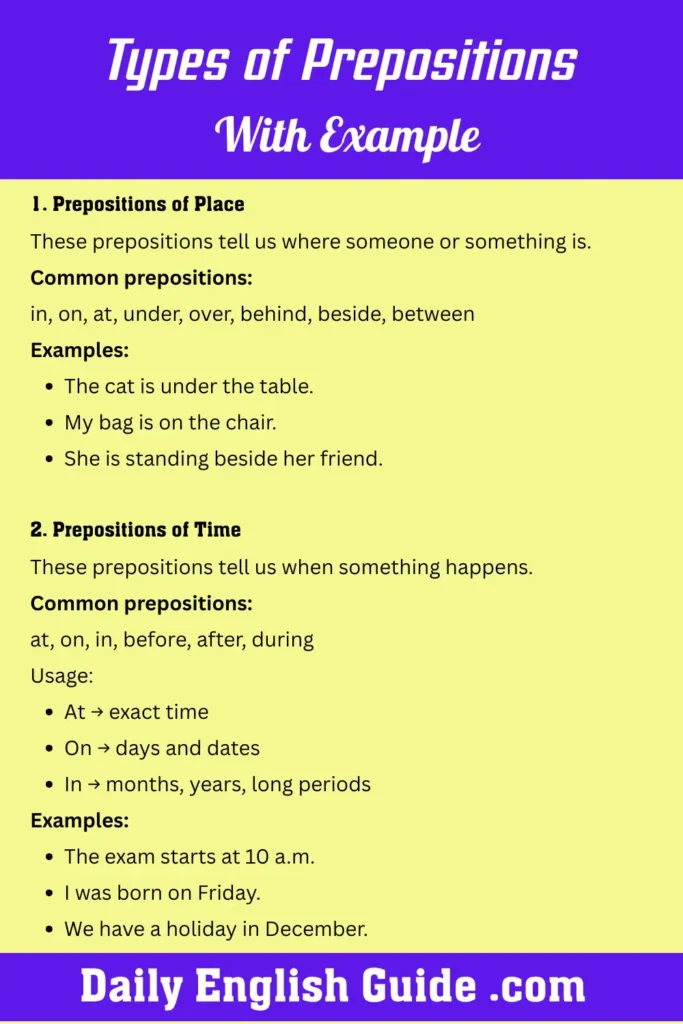
Prepositions of Place
These prepositions tell us where someone or something is.
Common prepositions:
in, on, at, under, over, behind, beside, between
Examples:
-
The cat is under the table.
-
My bag is on the chair.
-
She is standing beside her friend.
Prepositions of Time
These prepositions tell us when something happens.
Common prepositions:
at, on, in, before, after, during
Usage:
-
At → exact time
-
On → days and dates
-
In → months, years, long periods
Examples:
-
The exam starts at 10 a.m.
-
I was born on Friday.
-
We have a holiday in December.
Difference Between In, On, and At
This is one of the most important topics for students.
-
In → room, country, month
-
She lives in Dhaka.
-
-
On → surface, day
-
The book is on the desk.
-
-
At → exact point
-
Meet me at the gate.
-
Prepositions of Direction or Movement
These prepositions show movement.
Common prepositions:
to, into, onto, towards, across
Examples:
-
He is going to school.
-
The boy jumped into the river.
-
She walked across the road.
Prepositions of Manner and Instrument
These show how something is done or what is used.
Examples:
-
She goes to school by bus.
-
He cut the paper with a knife.
-
She sings like a professional singer.
Prepositions Used After Verbs and Adjectives
Some verbs and adjectives always take specific prepositions.
Common examples:
-
afraid of
-
interested in
-
good at
-
depend on
-
listen to
Sentences:
-
She is interested in music.
-
He is good at mathematics.
Commonly Used Prepositions
in, on, at, by, for, with, from, to, under, over, between, among, before, after, during, behind, beside, across, into, towards
Common Mistakes Students Make
-
❌ He is good in English.
✅ He is good at English. -
❌ She discussed about the topic.
✅ She discussed the topic. -
❌ Where are you at?
✅ Where are you?
Prepositions vs Conjunctions
-
Preposition → shows relationship
-
The book is on the table.
-
-
Conjunction → joins words or sentences
-
I like tea and coffee.
-
They are different and should not be confused.
50 Examples of Prepositions in Sentences
-
-
The book is on the table.
-
She is in the room.
-
The cat is under the chair.
-
We will meet at the school gate.
-
He lives in a small village.
-
The picture is hanging on the wall.
-
The ball rolled into the river.
-
She sat beside her mother.
-
The pen is between the books.
-
The boy ran across the road.
-
I go to school by bus.
-
She cut the paper with scissors.
-
The train arrived at night.
-
My birthday is in July.
-
The class starts at 9 a.m.
-
He was absent from school yesterday.
-
We stayed in the hotel for two days.
-
She stood in front of the mirror.
-
The children are playing in the park.
-
He walked towards the door.
-
The teacher is angry with the student.
-
She is afraid of dogs.
-
He is good at English.
-
They are interested in music.
-
The gift is for you.
-
The bird flew over the house.
-
The keys are on the shelf.
-
He jumped onto the stage.
-
The train passed through the tunnel.
-
The meeting will be after lunch.
-
She studied before the exam.
-
He was born on Monday.
-
The baby is sleeping in the cradle.
-
The shop is near my house.
-
The dog is hiding behind the tree.
-
I borrowed a pen from my friend.
-
She waited for the bus.
-
The boy fell off the bicycle.
-
He sat among his friends.
-
The farmer works in the field.
-
The train goes to Dhaka.
-
She came from school early.
-
The teacher talked about the lesson.
-
He looked at the sky.
-
The movie starts at 7 p.m.
-
The man walked along the road.
-
The book fell from the table.
-
She lives with her parents.
-
The child ran into the room.
-
The class ends after noon.
-
Why Prepositions Are Important
Prepositions help make sentences clear and meaningful. Correct use of prepositions improves:
-
writing skills
-
speaking fluency
-
exam performance
They are essential for good English grammar.
Practice Exercises
Fill in the blanks:
-
The cat is hiding ___ the bed.
-
My birthday is ___ July.
-
She goes to school ___ bus.
-
The book is ___ the table.
Answers: under, in, by, on
Conclusion
Prepositions may look small, but they are very powerful in English. By learning their types, rules, and common uses, students can greatly improve their English. Regular practice and reading simple sentences are the best ways to master prepositions.