
Have you ever wondered why some words name things while others describe actions, qualities, or feelings? Every word has a job in a sentence, and understanding that job can make English grammar much easier to learn.
These different word roles are called parts of speech. Once you understand them, it becomes easier to build sentences, recognize grammar patterns, and use words correctly in everyday English.
In this guide, you’ll learn the 8 parts of speech with definitions and examples, along with simple explanations that show how each one works in a sentence.
Quick Answer: What Are the 8 Parts of Speech?
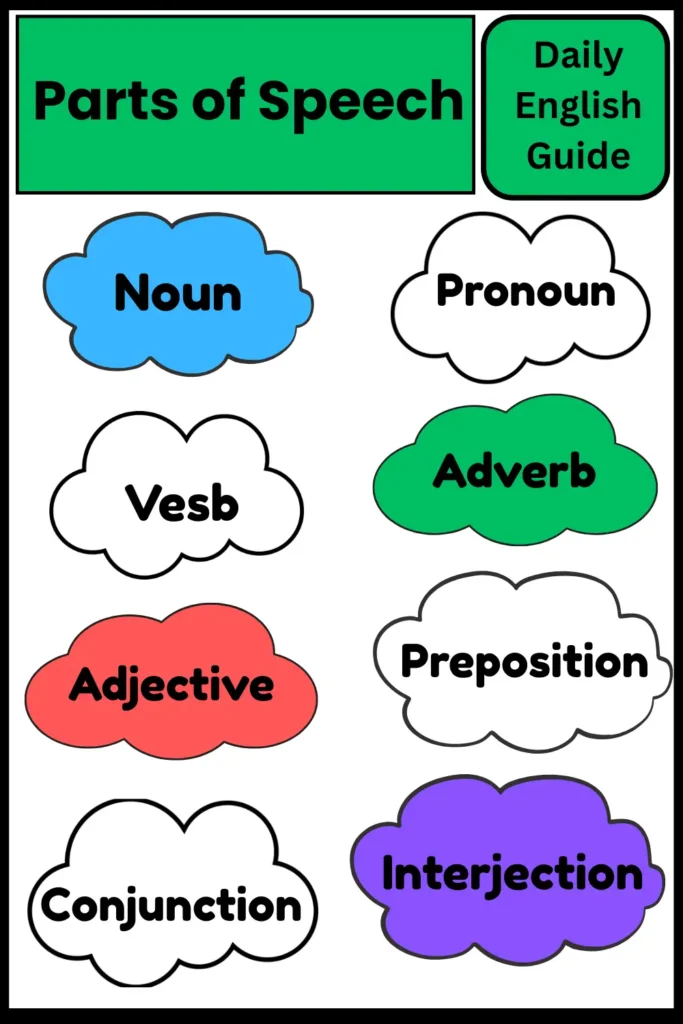
The 8 parts of speech in English are nouns, pronouns, verbs, adjectives, adverbs, prepositions, conjunctions, and interjections. Each has a different job in a sentence.
| Part of Speech | Main Job | Simple Example |
|---|---|---|
| Noun | Names a person, place, thing, or idea | Sara reads books. |
| Pronoun | Takes the place of a noun | She reads books. |
| Verb | Shows an action or state | She reads every day. |
| Adjective | Describes a noun or pronoun | It is a useful book. |
| Adverb | Adds information about a verb, adjective, or adverb | She reads quietly. |
| Preposition | Shows a relationship such as place, time, or direction | The book is on the table. |
| Conjunction | Connects words, phrases, or clauses | I like tea and coffee. |
| Interjection | Expresses a sudden feeling or reaction | Wow! That was amazing. |
A simple way to think about parts of speech is to ask, “What job is this word doing in the sentence?” The same word can sometimes belong to different parts of speech depending on how it is used.
Breaking Down the 8 Parts of Speech
Let’s explore each part of speech in detail, examining definitions, categories, and practical examples.
1. Nouns
Definition:
A noun is a word that names a person, place, thing, idea, or animal. Nouns are the foundation of most sentences and typically serve as the subject or object of a sentence.
Types of Nouns
-
Common Nouns: General names for things (e.g., car, city, teacher).
-
Proper Nouns: Specific names of people, places, or things (e.g., Sarah, Paris, Mount Everest).
-
Abstract Nouns: Names for things that cannot be touched or seen (e.g., love, freedom, happiness).
-
Collective Nouns: Words for groups or collections (e.g., team, family, audience).
Examples of Nouns in Sentences
-
She visited Paris last year. (Proper Noun)
-
The team played excellently. (Collective Noun)
-
Happiness is the key to success. (Abstract Noun)
2. Pronouns
Definition:
A pronoun is a word used to replace a noun in a sentence, usually to avoid repetition. Pronouns help make sentences more concise and clear.
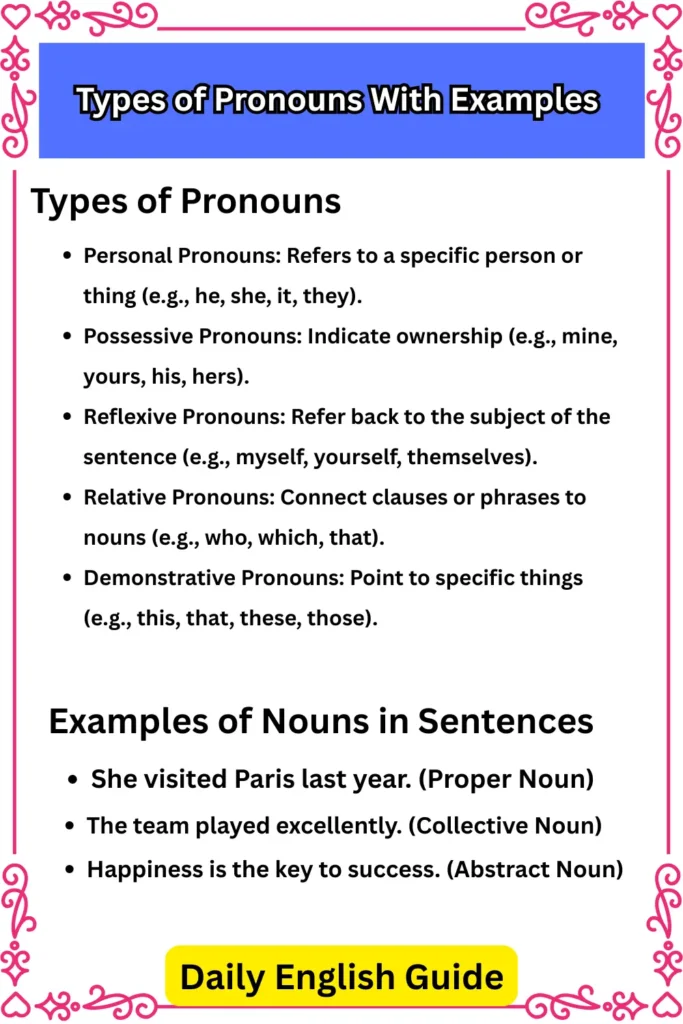
Types of Pronouns
-
Personal Pronouns: Refers to a specific person or thing (e.g., he, she, it, they).
-
Possessive Pronouns: Indicate ownership (e.g., mine, yours, his, hers).
-
Reflexive Pronouns: Refer back to the subject of the sentence (e.g., myself, yourself, themselves).
-
Relative Pronouns: Connect clauses or phrases to nouns (e.g., who, which, that).
-
Demonstrative Pronouns: Point to specific things (e.g., this, that, these, those).
Examples of Pronouns in Sentences
-
She is going to the store. (Personal Pronoun)
-
This book is mine. (Possessive Pronoun)
-
He completed the task himself. (Reflexive Pronoun)
-
The car that I bought is blue. (Relative Pronoun)
3. Verbs
Definition:
A verb is a word that expresses an action or state of being. Verbs are essential for forming sentences because they tell what the subject is doing or what is happening to the subject.
Types of Verbs
-
Action Verbs: Describe an action (e.g., run, jump, swim).
-
Linking Verbs: Connect the subject to a subject complement (e.g., is, are, was).
-
Auxiliary Verbs (Helping Verbs): Help the main verb express time, mood, or voice (e.g., have, will, can).
Examples of Verbs in Sentences
-
She runs every morning. (Action Verb)
-
He is a teacher. (Linking Verb)
-
I have finished my homework. (Auxiliary Verb)
4. Adverbs
Definition:
An adverb is a word that modifies a verb, adjective, or another adverb. It often tells us how, when, where, or to what degree something happens.
Types of Adverbs
-
Adverbs of Manner: Describe how an action is performed (e.g., quickly, slowly, carefully).
-
Adverbs of Time: Indicate when an action takes place (e.g., now, later, soon).
-
Adverbs of Place: Describe where an action happens (e.g., here, there, everywhere).
-
Adverbs of Frequency: Tell us how often something happens (e.g., always, often, never).
-
Adverbs of Degree: Show the intensity or extent of an action (e.g., very, too, quite).
Examples of Adverbs in Sentences
-
She sings beautifully. (Adverb of Manner)
-
I will call you soon. (Adverb of Time)
-
The dog runs everywhere. (Adverb of Place)
5. Adjectives
Definition:
An adjective is a word that describes or gives more information about a noun or pronoun. Adjectives help clarify the qualities, size, color, or state of the noun they modify.
Types of Adjectives
-
Descriptive Adjectives: Describe the qualities or characteristics of a noun (e.g., beautiful, tall, round).
-
Quantitative Adjectives: Indicate the quantity of a noun (e.g., some, many, few).
-
Demonstrative Adjectives: Specify which noun is being referred to (e.g., this, those, that).
-
Possessive Adjectives: Show ownership (e.g., my, his, her).
-
Interrogative Adjectives: Ask questions about nouns (e.g., which, what, whose).
Examples of Adjectives in Sentences
-
The small dog barked loudly. (Descriptive Adjective)
-
I have many books on my shelf. (Quantitative Adjective)
-
That book is mine. (Demonstrative Adjective)
6. Prepositions
Definition:
A preposition is a word that links nouns, pronouns, or phrases to other words in a sentence. Prepositions show the relationship between the object and other parts of the sentence, often indicating time, place, or direction.
Types of Prepositions
-
Prepositions of Time: Indicate when something happens (e.g., at, on, during).
-
Prepositions of Place: Show the location of something (e.g., in, under, between).
-
Prepositions of Direction/Movement: Indicate movement from one place to another (e.g., to, into, towards).
-
Prepositions of Agent/Instrument: Show the tool or agent involved in the action (e.g., by, with).
Examples of Prepositions in Sentences
-
She is sitting on the chair. (Preposition of Place)
-
We met at 5 p.m. (Preposition of Time)
-
He walked into the room. (Preposition of Direction)
7. Conjunctions
Definition:
A conjunction is a word that connects clauses, phrases, or words in a sentence. Conjunctions are crucial for forming complex sentences and showing the relationships between ideas.
Types of Conjunctions
-
Coordinating Conjunctions: Link words, phrases, or clauses of equal importance (e.g., and, but, or, nor, for, yet, so).
-
Subordinating Conjunctions: Join a dependent clause with an independent clause (e.g., because, although, if, unless).
-
Correlative Conjunctions: Work in pairs to link equal elements (e.g., either…or, neither…nor, both…and).
Examples of Conjunctions in Sentences
-
I wanted to go, but I was too tired. (Coordinating Conjunction)
-
She stayed home because it was raining. (Subordinating Conjunction)
-
Either you study hard, or you will fail. (Correlative Conjunction)
8. Interjections
Definition:
An interjection is a word or phrase that expresses strong emotions or sudden reactions. Interjections are often followed by an exclamation mark and can stand alone in a sentence.
Types of Interjections
-
Emotional Interjections: Express feelings or reactions (e.g., wow, alas, yippee).
-
Grammatical Interjections: Express mild emotions or fill pauses in speech (e.g., well, oh, hmm).
Examples of Interjections in Sentences
-
Wow! That was an amazing performance. (Emotional Interjection)
-
Oh, I forgot to call her. (Grammatical Interjection)
Summary of the 8 Parts of Speech
To recap, the 8 parts of speech are essential components of the English language. Each part serves a unique role in constructing meaningful and grammatically correct sentences. Here’s a quick summary:
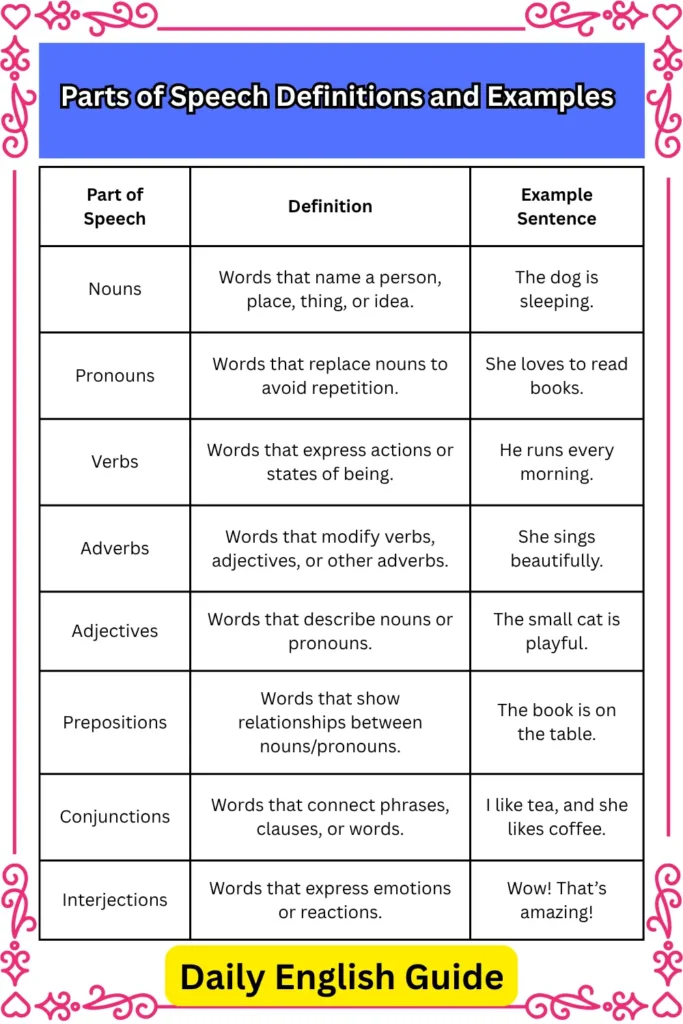
| Part of Speech | Definition | Example Sentence |
|---|---|---|
| Nouns | Words that name a person, place, thing, or idea. | The dog is sleeping. |
| Pronouns | Words that replace nouns to avoid repetition. | She loves to read books. |
| Verbs | Words that express actions or states of being. | He runs every morning. |
| Adverbs | Words that modify verbs, adjectives, or other adverbs. | She sings beautifully. |
| Adjectives | Words that describe nouns or pronouns. | The small cat is playful. |
| Prepositions | Words that show relationships between nouns/pronouns. | The book is on the table. |
| Conjunctions | Words that connect phrases, clauses, or words. | I like tea, and she likes coffee. |
| Interjections | Words that express emotions or reactions. | Wow! That’s amazing! |
Frequently Asked Questions About Parts of Speech
What Are the 8 Parts of Speech?
The 8 parts of speech are nouns, pronouns, verbs, adjectives, adverbs, prepositions, conjunctions, and interjections. Each has a different role in a sentence, such as naming something, showing an action, describing a word, or connecting ideas.
What Are Parts of Speech With Examples?
Parts of speech are groups of words classified by the jobs they do in sentences. For example, teacher is a noun, she is a pronoun, runs is a verb, happy is an adjective, and quickly is an adverb.
Why Are Parts of Speech Important?
Parts of speech help you understand how English sentences work. Learning them can make it easier to build correct sentences, choose the right words, and improve your speaking, reading, and writing skills.
How Can I Identify Parts of Speech in a Sentence?
Look at the job each word is doing. A noun usually names someone or something, a verb shows an action or state, an adjective describes a noun, and an adverb often gives more information about a verb, adjective, or another adverb.
Can a Word Be More Than One Part of Speech?
Yes. A word can belong to different parts of speech depending on how it is used. For example, run is a verb in “I run every morning,” but it is a noun in “I went for a run.”
What Is the Easiest Way to Learn the 8 Parts of Speech?
Start by learning the basic job of each part of speech, then study simple examples in sentences. After that, practice identifying nouns, verbs, adjectives, and the other word types in everyday English sentences.
Conclusion
Learning the 8 parts of speech gives you a strong foundation for understanding English grammar. Nouns, pronouns, verbs, adjectives, adverbs, prepositions, conjunctions, and interjections each have a different job, but they work together to create clear and meaningful sentences.
You do not need to memorize everything at once. Start with the basic definitions and examples, then practice identifying each part of speech in everyday sentences. The more you practice, the easier it will become to use English correctly and confidently.